
E. Margaret Burbidge
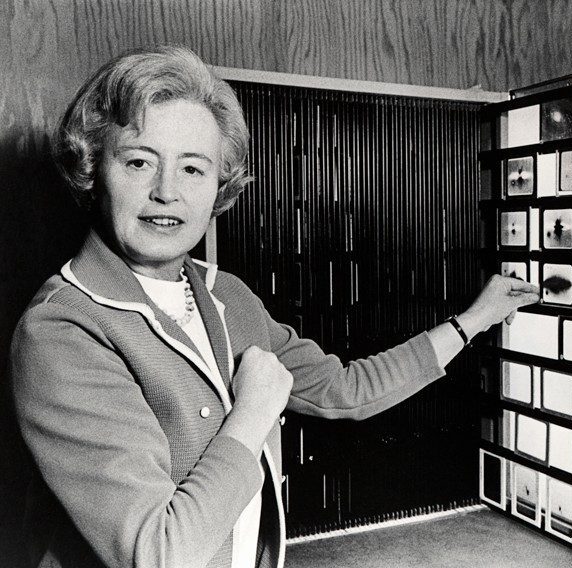
Astronomer at Yerkes, 1951-1953 & 1957-1962. Burbidge’s 1957 landmark paper proved that most heavy elements found on earth and in humans were formed in stars. She challenged sexism in science and was the American Astronomical Society’s first female president.
Kyle Cudworth

Astronomer at Yerkes, Director of Yerkes, 2001-2012. Cudworth compared photograph images of star clusters taken 80 years apart to measure star movement within the clusters. His observations facilitated estimating the distances to the clusters.
Carl Sagan

Graduate student at Yerkes, 1956–1960. Sagan studied under planetary scientist Gerard Kuiper and later became one of the world’s most recognizable science communicators, bringing the wonder of the cosmos to millions.
Nancy Grace Roman

Graduate student and research assistant at Yerkes, 1946–1954. Roman conducted research in stellar spectroscopy at Yerkes before becoming NASA’s first Chief of Astronomy. Her namesake telescope launched in August 2026.
Gerard Kuiper

Astronomer and twice director of Yerkes, 1937–1960. Often called the father of planetary science, Kuiper’s research transformed our understanding of the solar system. His work led to the identification of the region beyond Neptune now known as the Kuiper Belt.
Subrahmanyan Chandrasekhar

Astronomer at Yerkes, 1936–1950. “Chandra” made groundbreaking contributions to the study of stellar structure, stellar dynamics, and the life cycles of stars, work that would later earn him the Nobel Prize in Physics.
Otto Struve

Astronomer at Yerkes, 1921–1947. Struve arrived in America as a refugee following the Russian Revolution and began work at Yerkes as an observatory assistant. Within little more than a decade, he earned his Ph.D. and rose to become director of the observatory.
Edwin Hubble
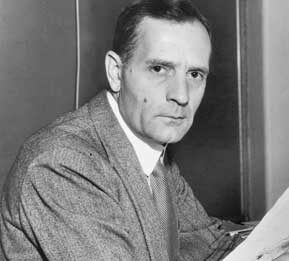
Graduate student at Yerkes, 1914–1917. Hubble transformed astronomy by demonstrating that galaxies exist beyond the Milky Way and discovering the universe is expanding, fundamentally reshaping our understanding of the cosmos.
Mary Ross Calvert

Astronomical computer and astrophotographer at Yerkes, 1905–1946. As one of the many women whose mathematical expertise supported the observatory’s research, Calvert contributed to the cataloging and study of dark nebulae and other celestial objects.
Sherburne W. Burnham

Astronomer at Yerkes, 1897-1914. Court reporter by day and amateur astronomer by night, Burnham received an appointment at Yerkes in 1897 and is credited with discovering 1,340 binary stars.