A Legacy In Motion

For more than a century, Yerkes has been a place of discovery, ambition, and breakthroughs. This is the story of how it came to life and the people who shaped what we know about the universe.

It Started With Two Lenses

In 1892, a young astrophysicist named George Ellery Hale learned of two 40-inch lens blanks sitting unused in a warehouse. With the support of University of Chicago president William Rainey Harper and a major investment from Charles Tyson Yerkes, that vision began to take shape.
When Yerkes opened in 1897, it brought together research, experimentation, photography, and education. Over the decades that followed, it attracted some of the most influential figures in astronomy, shaping how we understand the universe. What you see today is built on that legacy.
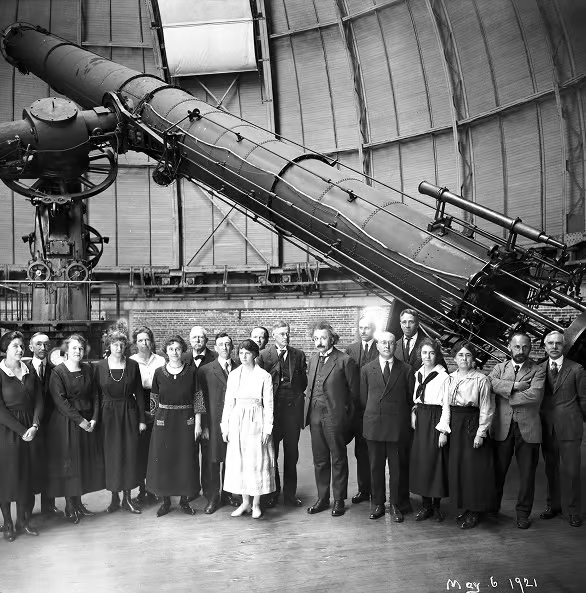
Historical black-and-white photo of a group at the Yerkes telescope
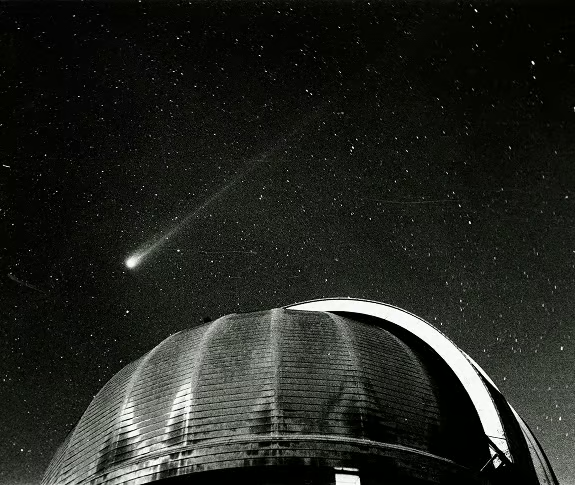
Historical photo of a comet in the night sky above Yerkes Observatory

Land and Sky Acknowledgement

At Yerkes, we recognize that our work takes place on the traditional homelands of the Potawatomi, Ho-Chunk, and Menominee peoples. For generations, these Nations have observed the skies and contributed deep knowledge to our understanding of the cosmos.
Though these communities were displaced, their cultural and celestial connections to this land continue. As we explore the universe, we honor their past, present, and future contributions and pay respect to the people, cultures, and Elders who have shaped both astronomy and the stewardship of this land.

The Story Over Time

From its earliest beginnings to today, each moment builds on the last, shaping the discoveries, people, and legacy that define Yerkes.
Historical photo of Yerkes Observatory under construction

1893

The tube of the Great Refractor is exhibited at the World’s Columbian Exposition in Chicago, offering a first glimpse of what’s to come.
Historical black-and-white photo of the Yerkes Observatory building

1895

Construction of Yerkes Observatory begins.
Historical black-and-white interior photo of Yerkes Observatory

1897

Yerkes opens and is formally transferred to the University of Chicago, marking the start of a new era in astronomical research.
Historical night photo of the Yerkes Observatory dome

1909

An early photograph of Pluto is captured at Yerkes, though its significance isn’t recognized at the time.
Historical photo of Yerkes Observatory during construction

1911

Yerkes is surpassed as home to the world’s largest telescope by the Mt. Wilson reflector, marking a shift in astronomical technology.
Historical black-and-white photo of the Yerkes Observatory building exterior

1921

Albert Einstein visits Yerkes during his first trip to the United States.
Historical night photo of the Yerkes Observatory dome silhouette

1943–1953

The Yerkes MKK spectral classification system is developed, becoming a foundational method for understanding stars.
Historical photo of a scientist at Yerkes Observatory

1951

Gerard Kuiper proposes the existence of what is now known as the Kuiper Belt, a region of icy bodies beyond Neptune.
Historical photo of Yerkes Observatory under construction with scaffolding

1960

Twin reflecting telescopes are added to the eastern towers, expanding the observatory’s capabilities.
Historical black-and-white photo of the Yerkes Observatory building

1983

Subrahmanyan Chandrasekhar is awarded the Nobel Prize in Physics for his work on stellar structure.
Night view of the Yerkes Observatory dome, historical photo

1991

Research at Yerkes contributes to the development of adaptive optics, improving how telescopes observe space.

Yerkes Observatory dome viewed from outside, historical photo

2020

The University of Chicago transfers Yerkes Observatory and surrounding land to Yerkes Future Foundation, ensuring its preservation and future.

The Who's Who of Astronomy

If astronomy had a walk of fame, it would be here. Yerkes has drawn some of the most influential minds in science, many of whom helped shape how we understand the universe.

Let's
Plan
Your Visit

See what’s happening and choose the experience that’s right for you, with options for every type of visit.